

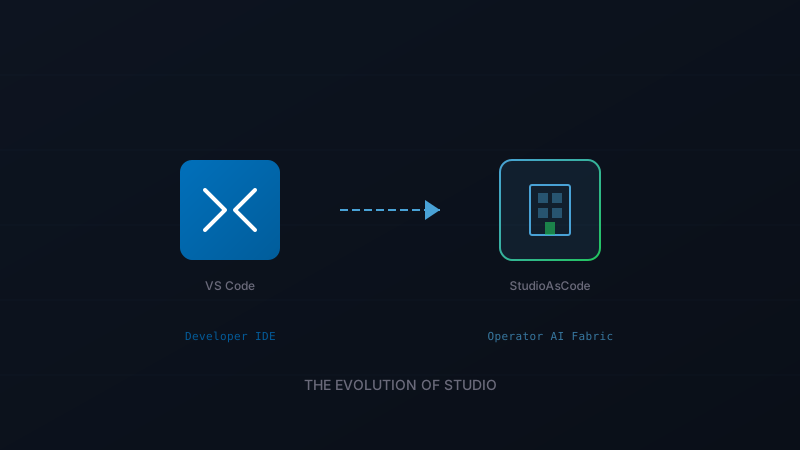
TL;DR: Developers wrote code in VS Code. Operators now run companies as code in StudioAsCode. This is the logical continuum - from IDE to AI-native operational fabric.
The Problem
We’ve all seen it: compliance tracked in spreadsheets that nobody updates. Security policies buried in Confluence pages that drift from reality. Audit trails scattered across email threads and Slack messages.
When we started building cloud infrastructure for regulated industries, we kept hitting the same wall - governance tools designed for a slower era couldn’t keep pace with modern operations. So we asked: what if governance worked like code?
The Evolution of “Studio”
The term “studio” has always meant workspace - a place where craft meets discipline, where creation happens with precision.
Visual Studio Code revolutionized the developer experience. It made code editing fast, extensible, and reproducible. It brought the developer workspace into the modern era.
But code is only one part of the organizational equation.
StudioAsCode represents the next evolution: from writing code to running systems - not just applications, but entire organizations - as code.
The Bridge Between Developer and Operator
Visual Studio Code gave developers a reproducible environment for building applications.
StudioAsCode gives operators a reproducible environment for building companies - where governance policies, compliance workflows, and operational decisions live in Git, not spreadsheets.
The Mental Model Shift
| Layer | Visual Studio Code | StudioAsCode |
|---|---|---|
| Environment | IDE for developers | AI-Native Fabric for operators |
| Focus | Code editing & debugging | Organizational orchestration |
| Scope | Application logic | Compliance, governance, security |
| User | Software developer | Operator / DevOps Lead / AI Engineer |
| Output | Compiled applications | Auditable organizational state |
| Version Control | Git for source code | Git for everything |
Where VS Code made development reproducible, StudioAsCode makes operations auditable.
Workflows no longer live in Excel sheets or Confluence pages that drift from reality. They live in Git - versioned, traceable, and executable. Our incident response procedure isn’t a static wiki page - it lives as code in a Git repo, with each update tracked and requiring review.
StudioAsCode as the Operational Control Plane
The Operator-as-Code concept extends DevOps into a new paradigm:
- DevSecOps - Security embedded from infrastructure up
- Compliance-as-Code - Frameworks codified for continuous validation (with human oversight where needed)
- AI Governance - Policy enforcement at the model boundary via runtime checks
- Change Records - Every decision logged with operator attribution
StudioAsCode aims to become the operational control plane for the AI-native company - not by replacing human judgment, but by encoding organizational knowledge into enforceable, auditable workflows.
What This Looks Like in Practice
Under the hood, every command an AI agent or operator executes passes through a seven-layer validation gateway:
- Tool whitelist - Is this action permitted?
- Resource access - Can this operator touch this resource?
- Command safety - Does this command match allowed patterns?
- Content validation - Does output comply with content policies?
- PII detection - Are we about to leak sensitive data?
- Model routing - Is the right AI model handling this task?
- Compliance validation - Does this action satisfy framework requirements?
Only after passing all seven layers is an action allowed to execute. This ensures security and compliance are enforced by design, not after the fact.
From Development to Operation
Visual Studio Code democratized software development. You didn’t need expensive enterprise IDEs - you could build world-class applications from a lightweight, extensible editor.
StudioAsCode follows the same philosophy for operations:
- You don’t need enterprise GRC platforms that cost six figures.
- You don’t need armies of consultants delivering shelfware.
- You need infrastructure that enforces governance by design.
Concrete example: We consolidated a sprawling governance setup into a lean template structure - reducing maintenance from per-repo updates to a single source of truth.
Why the Name Matters
The naming symmetry is intentional:
- Visual Studio Code - the IDE for engineers
- StudioAsCode - the fabric for operators
The name links the concept of a “studio” (workspace) with “as code”, aligning with how practitioners mentally group Visual Studio Code and infrastructure-as-code tools.
Visual Studio Code represented a shift from heavyweight IDEs to lightweight, extensible workspaces.
StudioAsCode represents the shift from heavyweight governance platforms to infrastructure-first, code-driven organizational management.
The Philosophical Continuum
Then: Developers
VS Code gave developers:
- Extensibility through plugins
- Git integration for version control
- IntelliSense for context-aware editing
- Terminal access for command-line operations
Now: Operators
StudioAsCode gives operators:
- MCP (Model Context Protocol) servers for AI tool integration
- Git-based governance for organizational version control
- Policy-as-code for compliance automation
- CI/CD pipelines for operational workflows
The same principles that made VS Code popular - like an extension ecosystem and lightweight footprint - are evident in StudioAsCode’s design: modular policy files, plugin-like integration for AI tools, and a focus on transparency over black-box magic.
What This Means for the AI-Native Company
Visual Studio Code assumed developers would write code.
StudioAsCode assumes operators will orchestrate AI systems to manage compliance, governance, security, and infrastructure.
This isn’t about replacing human judgment - it’s about augmenting human capability with:
- Automated evidence collection for audits
- Continuous compliance validation against frameworks like ISO 27001, SOC 2, GDPR
- Chain of custody for all organizational changes
- Tamper-evident archives for regulatory requirements
Real Evidence, Not Marketing Claims
StudioAsCode doesn’t just claim to be auditable - it maintains an evidence registry of every significant action. Each record is timestamped, labeled with the operator or AI agent responsible, and hashed for integrity.
A typical evidence record looks like this:
{
  "operation_id": "op_2025_a1b2c3d4",
  "timestamp": "2025-11-15T14:32:09.182893Z",
  "operator_id": "ai-agent-prod",
  "decision": "ALLOWED",
  "validation_results": [
    {"layer": "access_control", "passed": true},
    {"layer": "policy_check", "passed": true},
    {"layer": "compliance", "passed": true}
  ]
}
This isn’t theoretical - it’s running infrastructure generating tamper-evident audit trails daily.
The Architecture
Just as VS Code provided:
Editor → Extensions → Terminal → Git → OutputStudioAsCode provides:
Governance → Policy Engine → MCP Tools → Git → Audit TrailThe workspace evolved. The IDE became a fabric.
Authority Boundaries
A critical difference from traditional tools: StudioAsCode enforces a three-level authority model:
- Contributors (AI Agents) - Can prepare, analyze, recommend. Cannot approve.
- Reviewers (Human Operators) - Can review, test, approve for staging.
- Certifiers (Governance Authority) - Can certify for production, sign evidence.
AI agents are explicitly forbidden from signing off, verifying, or certifying their own work. This boundary is enforced in code, not just policy documents.
The Shared Philosophy
Both VS Code and StudioAsCode share core principles:
- Extensibility - Build what you need through plugins/tools
- Transparency - Source code is visible and auditable
- Git-native - Everything versioned, everything traceable
- Lightweight - No bloated enterprise overhead
- Community-driven - Open frameworks, shared standards
VS Code didn’t compete with Visual Studio. It redefined what a code editor could be.
StudioAsCode doesn’t compete with enterprise GRC platforms. It redefines what organizational governance can be.
From Code to Company
Visual Studio Code taught the industry that developer tools should be:
- Fast
- Extensible
- Open
- Git-integrated
StudioAsCode applies those same principles to operations:
- Governance should be fast (automated, not manual)
- Compliance should be extensible (modular frameworks, not monolithic systems)
- Policies should be open (auditable, not black-box)
- Everything should be Git-integrated (versioned, traceable, reproducible)
The Vision
If Visual Studio Code made development accessible to millions of developers…
StudioAsCode aims to make governance accessible to thousands of operators.
The next workspace isn’t an IDE.
It’s an AI-native operational fabric where companies run as code, compliance is validated continuously, and every change is auditable by design.
The Reality Check
This isn’t a finished product. This is an architectural direction under active validation.
Just as VS Code evolved from beta to the world’s most popular editor, StudioAsCode is evolving from research to production-grade infrastructure.
The proof isn’t in the pitch deck. It’s in the commits.
The Path Forward
Visual Studio Code redefined the developer workspace.
StudioAsCode is redefining the operator workspace.
The philosophy is the same:
Lightweight. Extensible. Git-native. Transparent.
The application is different:
Not just writing code. Running companies as code.
Visual Studio Code gave developers a workspace to build applications.
StudioAsCode gives operators a workspace to build organizations.
This is the next evolution of “studio.”
Welcome to the Operator AI Fabric.
We’re actively validating this approach. If this vision resonates with how you think about governance and operations, let’s connect.